Closing Reporting Gaps: Avoiding Manipulation and Greenwashing
Sustainability reports are supposed to create transparency and show how companies are taking responsibility for environmental and social issues. In practice, however, this goal is often missed: instead of clear facts, it is not uncommon to find embellished representations that serve the company’s image rather than providing actual information. This so-called greenwashing ranges from overly positive claims of environmental friendliness to questionable climate pledges or CO₂ offsets of doubtful value. Similar strategies also exist in the social sphere in the form of bluewashing. For example, when companies advertise with big symbols such as the UN Agenda without actually implementing anything. Another problem lies in the key figures themselves, as much of the data is based on assumptions and estimates. This makes comparisons difficult—and creates opportunities to deliberately embellish ESG data.
TRR 266 research shows where improvements are needed and what regulators can do to prevent manipulation and greenwashing.
Manipulation, Greenwashing & Cherry Picking
In recent years, companies have been under growing pressure to show how they care about the environment, society, and good governance (ESG). New rules, like the European Sustainability Reporting Standards (ESRS), are meant to make this kind of reporting more transparent and comparable. Quantitative information – hard and verifiable facts – may contribute to this. However, ESG reports also consist of qualitative, narrative parts. Information that is difficult to verify and open to interpretation. That leaves room for managers to present information in ways that make their companies look better than they really are. Do firms use this grey area to their advantage? And how do reporting mandates might improve this?
TRR 266 research shows this:

Managers present ESG information strategically
These study results show that managers present soft information strategically in mandatory financial disclosure settings. This behavior also applies to ESG reporting, as this is largely based on vague, less verifiable information. This gives managers the opportunity to use tone strategically to shape investors’ and analysts’ expectations. The researchers find that when the outlook for performance is favorable, managers tend to strike an overly positive tone. Less favorable prospects are often communicated more cautiously, for example in less visible areas or reported in a way that is difficult to understand. Even mandatory information can be presented in such a way as to deliberately influence the reader’s perception – e.g., through placement, graphic presentation, or embedding in a positive context.
In making this decision, they must weigh the short-term benefits against the risks of potential future damage to their image. In the short term, targeted presentation can positively influence investor perception. In the long term, however, the strategy could harm the company if it later turns out that information has been exaggerated. In addition, the likelihood of biased reporting increases when a manager’s compensation is strongly linked to performance and internal controls are weak.
To avoid extreme distortions in reporting, companies and regulators need to strike a balance between incentives and internal controls. Without strong internal controls, the same incentives can lead to overly biased and less trustworthy reports.
Read the publication:
Contact the researcher:

Disclosure of tax strategy encourages greenwashing
Taxes are increasingly seen as part of corporate social responsibility. Nationally and internationally, regulations require multinational companies to disclose more information about their tax affairs in order to make their actions more transparent and ensure compliance with tax laws.
A new study examines the impact of the UK’s 2016 Tax Strategy Mandate, a qualitative regulation that requires large companies to disclose their tax strategies. The regulation aims to increase transparency and reduce tax avoidance.
The results show that while companies expanded the scope of their tax strategy disclosures in their annual and individual reports, the content became largely standardized and repetitive. Notably, the mandate had no measurable impact on actual tax planning or avoidance. Effective tax rates and the use of tax havens remained unchanged.
The researchers therefore conclude that the mandate has encouraged companies to portray themselves as responsible taxpayers without changing their actual practices. In other words, the disclosure requirement may have led to a form of greenwashing, where good behavior is signaled through words rather than deeds.
These findings raise critical questions about the effectiveness of qualitative disclosure requirements. Unlike quantitative information, qualitative disclosures are difficult for outsiders to verify. This makes public pressure less effective in changing corporate behavior. In practice, companies respond by providing more detailed explanations to protect themselves from criticism, but this often reduces the overall quality of their reporting, even in important documents such as annual reports. Since UK tax strategy reports are very similar to other types of qualitative CSR disclosures, which are becoming increasingly common, the findings are particularly relevant for policymakers deciding whether to rely on qualitative disclosure requirements. Without stricter verification mechanisms, there is a risk that such measures will lead to PR rhetoric rather than meaningful corporate change.
Read the publication:
Contact the researchers:
Closing reporting gaps: How to make corporate carbon accounting more decision-useful
Given that 2024 was the hottest year on record, the urgency of creating effective carbon accounting systems cannot be overstated. In the global effort to mitigate climate change, corporate carbon reporting has become a central element of climate policy and corporate governance. Many firms now disclose greenhouse gas emissions and set net-zero targets, often in response to regulatory requirements and investor expectations. At the same time, there is growing concern that current reporting practices do not always provide transparent, comparable, and decision-useful information. TRR 266 research suggests that existing frameworks require further refinement to achieve this, and that accounting researchers can make an important contribution to this process.

How reliable are ESG metrics?
Many ESG metrics are subject to potential inaccuracies. In particular, data on Scope 3 emissions or biodiversity is often based on estimates and assumptions, for example about customer usage behavior or environmental impacts along the value chain. Such inaccurate information gives companies considerable room for discretion. And they also have a cascading effect: distortions in one company’s data flow directly into the key figures of other companies, such as banks that have to report their financed emissions. As a result, ESG figures are difficult to compare and lose their informative value.
Limits of Transparency
Moreover, the idea of transparency reaches its limits where even strict prohibitions are barely enforceable. For example, if companies are able to circumvent child labor regulations in their supply chains, it seems even more unrealistic to expect them to voluntarily provide detailed reports on problematic practices. Where reporting has direct consequences for financing, ratings, or customer commitments, the same incentives apply as in the financial world: legal but systematic distortions within the permitted rules. As a result, sustainability reporting risks to become more of a public relations tool rather than making a genuine contribution to transformation.
Control Mechanisms
In addition, the control mechanisms in the field of sustainability reporting are still far less developed than those in financial reporting. Neither public enforcement nor independent audits are currently established to the same extent. External auditors are usually only able to provide “limited assurance” of the reports. This also highlights the importance of training for auditors. Expertise in ESG auditing should already be taught during business studies programs at university and cannot be left solely to the major auditing firms.
More information in this article:
Contact the researcher:

Limitations of current reporting practices under the GHG protocol
The GHG Protocol, the most widely used framework for reporting corporate greenhouse gas emissions, requires companies to disclose their emissions in three areas:
• Scope 1: direct emissions from operations
• Scope 2: indirect emissions from purchased energy
• Scope 3: indirect emissions along supply chains
Yet, this TRR 266 study explains that emissions figures reported today often make it difficult for analysts to assess the actual decarbonization progress of firms or to compare performance across companies and over time. They can also weaken incentives for real decarbonization, as firms cannot take credit for emissions reductions when reported figures are based on industry averages.
Recent research highlights that many of these limitations are rooted in how carbon accounting systems are designed and implemented. A common practice today is that firms hire consulting firms to estimate their emissions based on secondary data. As these estimates are not grounded in firms’ own transactional data, they are often less accurate, difficult to verify, and of limited use for internal decision-making. Transactional, in-house carbon accounting systems instead rely on firms’ actual operational data. This approach can actually strengthen incentives to reduce emissions in practice.
Related Publications:
How carbon accounting rules shape incentives for hydrogen production
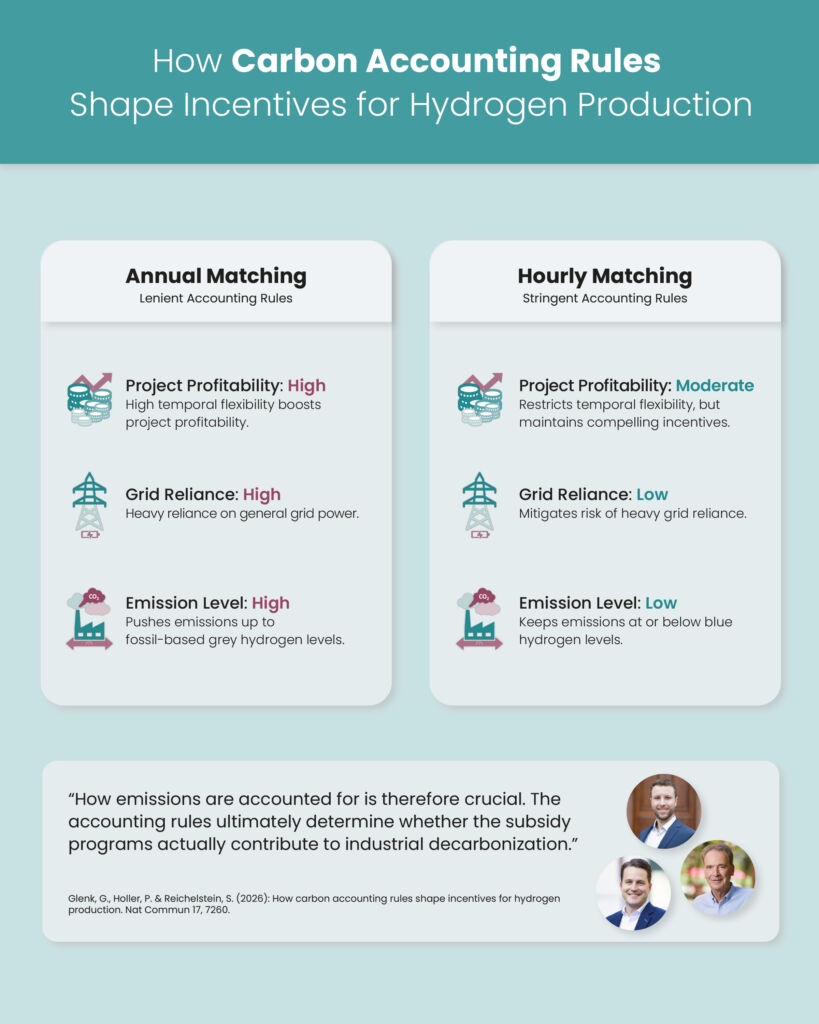
Governments worldwide have recently adopted policy support programs for hydrogen, tying the level of support to the assessed carbon intensity of the hydrogen produced. New research compares alternative carbon accounting rules for determining the policy support available for hydrogen in terms of the resulting financial and carbon emissions performance of hydrogen production.
Contrary to frequently articulated views, the study shows that stringent (hourly matching) rules provide investors with sufficient incentives to invest in hydrogen systems. Yet, such rules can result in “green” hydrogen that is nearly as carbon-intensive as “blue” hydrogen from natural gas with carbon capture. Lenient (annual matching) rules increase returns but also push emissions towards “grey” hydrogen from fossil fuels, as investors procure more carbon-intensive electricity from the general grid.
Overall, the study shows that accounting rules ultimately determine whether the subsidy programs actually contribute to decarbonization. The insights speak directly to ongoing policy discussions in the US and the EU on how to support the emergence of clean hydrogen without causing substantial emissions.
Accounting-Based Approaches to Carbon Measurement
TRR 266 researchers propose adapting core principles from financial accounting to corporate carbon accounting. In particular, they suggest an accounting architecture that distinguishes between emissions in the current period (flows) and emissions embodied in assets such as inventories and equipment (stocks). This structure allows firms to reconcile emissions over time through standardized carbon statements, analogous to income statements and balance sheets, and ensure temporal consistency and internal coherence. By tracking both stocks and flows, firms can explain changes in reported emissions, link product-level footprints to firm-level totals and make long-term decarbonization pathways more transparent and credible.
How Product Carbon Footprints can improve CO₂ Emissions Measurement across Supply Chains
Product carbon footprints play a key role in developing more precise systems to measure CO₂ emissions across entire supply chains. The research emphasizes sequential, supply-chain-based methods in which each supplier passes along verified emissions information with its products. When applied consistently, this approach avoids double counting and replaces industry averages with firm-specific data. Such methods also generate management-relevant indicators that support operational decisions and investment planning.
Implications for Regulators and Decision-Makers
These challenges are particularly relevant as widely used standards are currently under revision and continue to evolve, alongside the introduction of new mandatory disclosure regimes. Importantly for regulators and standard setters, these accounting-based frameworks are presented as complements rather than substitutes to existing disclosure regimes. They are designed to be compatible with current standards and regulatory initiatives, including the EU Corporate Sustainability Reporting Directive, while leaving room for policy choices on system boundaries, allocation rules, and the treatment of carbon credits. Given that current standards are still evolving, this research can help refine accounting rules to make emissions data more consistent, auditable and useful for both regulatory oversight and corporate decision-making.
TRR 266 Researcher Gunther Glenk on Improving the Greenhouse Gas Protocol:
Integrated Corporate Carbon Accounting explained by CASI (Carbon Accounting Standards Initiative):
Further information:
Contact the researchers: